Stone Island Knitwear Fit Check for Commuters
- Published
- 13 October 2026
- Revised
## What This stone island Knitwear Verification Helps You Decide If you're planning to buy a stone island knit for fall/winter smart-casual office wear, what you need to solve first isn't "does it look convincing," but three actionable questions: does the product page actually correspond to a knit, will the sizing accommodate layering for your commute, and are the fabric and thickness details sufficient to support a purchase decision. This verification is based on the fashion-reps page visible a
What This stone island Knitwear Verification Helps You Decide
If you're planning to buy a stone island knit for fall/winter smart-casual office wear, what you need to solve first isn't "does it look convincing," but three actionable questions: does the product page actually correspond to a knit, will the sizing accommodate layering for your commute, and are the fabric and thickness details sufficient to support a purchase decision.
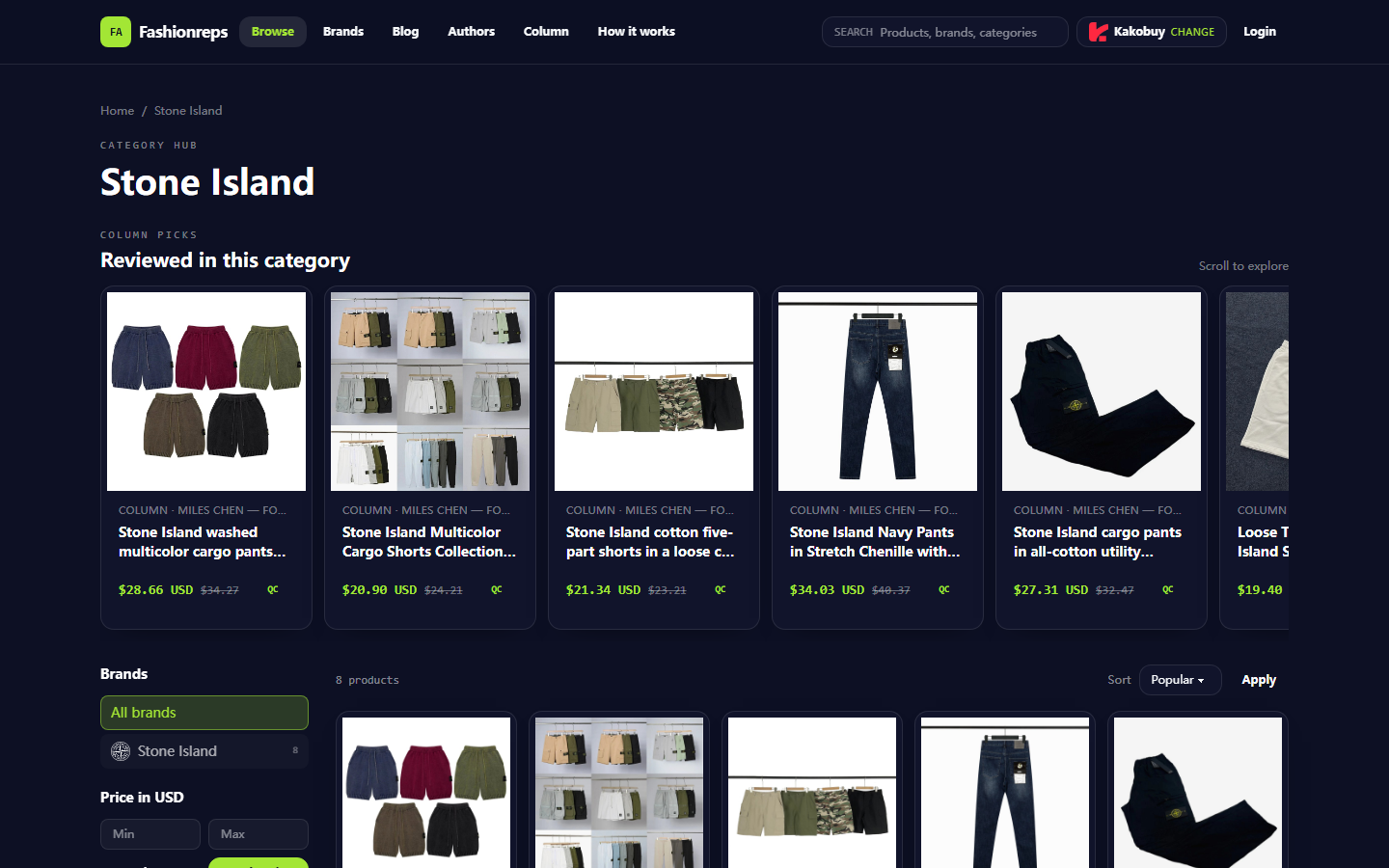
This verification is based on the fashion-reps page visible as of October 12, 2026. The screenshot provided shows a Stone Island pants category page displaying trousers, shorts, and track pants, with no fall/winter knitwear product details available for confirmation. Therefore, this article will not treat pants page information as knitwear facts, nor will it fabricate knit pricing, stock, fabric, reviews, or actual fit.
After reading, you should be able to determine:
- Whether the current product page is worth further verification;
- Which sizing and fabric details must be obtained;
- Whether this knit suits office, commuting, and indoor-outdoor temperature changes;
- Given insufficient information, whether to hold off ordering, request evidence from the seller, or look at other items.
This article does not apply to confirming authenticity, verifying brand genuineness, determining official authorization, or replacing customs, tax, and platform after-sales policies of the destination country. The fashion-reps page is for discovering and reviewing products, with purchase buttons linking to user-selected external shopping agents; orders, payments, and shipping are handled by agent sites. 🧭
First Confirm the fashion-reps Product Page, Style, and Available Sizes
The first step is to confirm the page's subject, not just rely on words like "knit," "sweater," or "Stone Island" in the product title. Check whether the page satisfies all of the following:
- The page clearly states knitwear, sweater, cardigan, knit jacket, or similar category;
- The main and detail images show an upper garment, not pants, shorts, or accessories;
- The page lists selectable sizes, not just colors or random sizing;
- The page provides at least some measurable information like chest width, shoulder width, length, or sleeve length;
- The product description does not mix different styles, fabrics, and links into an indistinguishable collection page;
- The purchase button leads to the corresponding product flow on the chosen shopping agent.
The visible screenshot shows a Stone Island page under the pants category, displaying 8 pant-related items, with brand filters, price filters, reference prices, and QC entry points. This information explains the navigation and purchasing agent logic of the category page, but it does not prove the existence of a fall/winter knit for verification.
Therefore, upon seeing a similar title, first classify the page:
| Item to Check | Acceptable Evidence | Current Status |
|---|---|---|
| Product Category | Page title, main image, and details all point to a knit top | No knitwear evidence in screenshot |
| Style Range | Clear distinction between crewneck, half-zip, cardigan, or knit jacket | Not yet verified |
| Size Info | Specific size chart with cm or inch units | Not yet verified |
| Fabric & Care | Fiber composition and care instructions in product details | Not yet verified |
| Purchase Path | Product button enters user-selected external agent | Visible on-site purchase agent flow |
If the product page only shows a category collection, do not treat the collection as a specific product page. Enter the individual product page, then record title, specs, sizes, images, and visible description.
Verify Fabric, Thickness Description, and Care Instructions from Visible Page Info
Fall/winter office suitability cannot be determined solely by adjectives like "thick," "warm," or "premium material." For knits, you need to separately check fiber composition, knit structure, thickness, elasticity, surface treatment, and care instructions.
Read product details in this order:
- Look for specific fiber names and percentages, such as cotton, wool, acrylic, polyamide, or blends. Only when percentages are stated can you record them as page fabric facts.
- Look for knit or structure descriptions, such as ribbed, jersey, chunky, jacquard, cable, or fine knit. Without explicit statements, do not infer from images.
- Check thickness, weight, or seasonal cues. If the page only says "fall/winter style," that is just a seller label, not quantifiable warmth.
- Check whether elasticity, pilling, shrinkage, color fading, or deformation risks are described. No mention does not mean no risk, only that the page provides no evidence.
- Read washing and drying recommendations. Styles requiring dry cleaning, flat drying, or avoiding high heat may have higher maintenance costs for frequent office wear.
Images can help confirm visual cues like collar, cuffs, texture, and thickness, but cannot prove actual hand feel, warmth, or fiber content. Even if the knit texture looks clear, you cannot write "soft," "thick," or "won't pill" based solely on that. 🧶
If the page only has product images without fabric tags, care labels, or close-up details, record "fabric not fully verified" in your purchase notes. Do not fill gaps with brand's typical fabrics, search results for similar items, or other product details.
Use Size Chart to Assess Shoulder Width, Length, and Layering Space
For office knitwear, sizing is not just about picking your usual letter size; confirm shoulder mobility, layering space, and length suitability for your scenarios.
Prioritize recording these measurements:
- Shoulder width: assess if layering with shirts, thin base layers, or light hoodies causes pulling;
- Chest or body width: assess if sitting, wearing a backpack, or raising arms causes excessive tightness;
- Length: assess if layering with dress pants, jeans, or outerwear causes the inner layer to show;
- Sleeve length: assess if wrists ride up during movement or if sleeves visibly protrude from jacket cuffs;
- Hem and cuff width: assess if they easily roll up, bind, or deform over time.
When measuring, first confirm whether the seller provides body measurements or garment measurements. They cannot be mixed. If only flat lay measurement images are provided, confirm measurement points, units, and potential manual error, and compare with your own well-fitting knit using flat lay method.
For office layering, assess three scenarios:
- Wearing only a shirt or short-sleeve base layer: a more fitted body is acceptable, but shoulders and chest need room for arm movement;
- Layering a thin thermal layer: extra attention to chest, armhole, and sleeve length to avoid bunching under arms;
- As an inner layer under outerwear: length and cuffs should coordinate with outer layer; excessive thickness or loose hem may affect sitting posture and jacket closure.
Without a size chart, do not order based solely on model height, S-XL in product title, or "true to size" comments. Model info cannot replace your shoulder width, chest, and usual base layer size. 📏
Distinguish Product Page Facts, Community Feedback, and Editorial Judgment
The most confusing aspect in purchase decisions is mixing three types of information: page facts, user feedback, and editorial inference. They have different evidentiary weights and should not be written in the same tone.
Page facts include style name, size chart, fabric text, images, visible price, stock status, and purchase button explicitly shown on the product page. Highly volatile info must include verification date, currency, and applicable conditions.
Community feedback can only be used when the original post, context, and thread completeness can be confirmed. If comments are deleted, replies aren't expanded, or the thread cannot be fully read, mark it as partially read at most, and never treat a single comment as a general conclusion. Without verifiable community samples, do not write "buyers generally think" or "many people report."
Editorial judgment is inference about office scenarios based on verified information. For example, if the page clearly provides a roomy chest, sufficient length, and product images showing suitability as an inner layer, you can cautiously state: "Based on measurements, it's likely suitable for layering." But this is not an actual try-on conclusion.
The available material does not provide a knitwear product page, complete size chart, fabric tags, or community discussions. Therefore, currently we can only confirm the platform category page's navigation and external agent purchase path, not the fit, hand feel, warmth, pilling performance, or office comfort of any specific knit. Editorial perspective should maintain this boundary, not package missing evidence as a recommendation. 🔎
Styling and Usage Boundaries for Fall/Winter Office Scenarios
Before evidence is complete, use scenario requirements to deduce what information is needed, rather than accepting promotional adjectives on the product page.
Office scenarios typically focus on whether the collar deforms easily, whether the body is overly wide, whether cuffs interfere with keyboard or document handling, and whether layering under outerwear looks bulky. If the page lacks clear images of collar, cuffs, and side body, keep these items as pending confirmation.
Commuting scenarios also consider backpack straps, seat friction, and frequent putting on/taking off. If the product description does not mention abrasion resistance, anti-pilling, or care instructions, do not infer it's suitable for daily high-frequency use. Actual durability of knits requires direct evidence of materials, structure, or long-term feedback.
Indoor-outdoor temperature changes require ease of removal and wearing. Crewneck, half-zip, and cardigan usage differs; thickness, sleeve length, and body length affect coordination with outerwear. Without specific style and measurement data, do not prematurely judge which is best for your office environment.
Brand logos, badges, or similar designs do not equal authenticity proof. If your purchase goal is a genuine product or official source, separately verify authorization, source, and destination country legal requirements; do not use fashion-reps page display or QC entry as brand authentication.
Evidence Request Checklist for Missing or Contradictory Information
When requesting evidence from seller or external agent, ask specific questions that yield storable answers:
- Please provide a flat lay size chart for this specific style, with measurement units;
- Please confirm whether the size chart is garment measurements or recommended body measurements;
- Please provide close-up photos of collar, cuffs, hem, side, and inside labels;
- Please confirm fiber composition and percentages, and whether different colors use different fabrics;
- Please state any warnings regarding shrinkage, pilling, color fading, or deformation;
- Please provide care instructions, especially dry clean, flat dry, or avoid dryer recommendations;
- Please confirm currently available colors, sizes, and page price, recording verification date and currency;
- Please confirm that the product page, agent order page, and QC images correspond to the same style.
If the page title says knit but images show pants; size chart doesn't match product images; fabric descriptions contradict each other; or the purchase button cannot locate the specific style, hold off ordering. The safest action is to save the page and screenshots, ask seller or agent for clarification, and not substitute info from similar items.
Pre-Order Verification Checklist and Next Steps
Before ordering, complete the following records in order:
- Save the specific product page title, URL, and verification date.
- Confirm the page is indeed for stone island knit top, not a pants category or mixed collection.
- Record available sizes, colors, page price, currency, and stock status; mark missing as not provided.
- Compare your shoulder width, chest, usual base layer length with seller's garment measurements item by item.
- Save original text or screenshots of fabric, knit structure, thickness description, and care instructions.
- Separately record page facts, verifiable community feedback, and editorial judgment.
- Confirm the purchase button leads to your chosen external agent and understand that order, payment, shipping, and after-sales are handled by the agent site.
- Until evidence is completed, do not treat "fall/winter style," "premium material," or model photos as office suitability conclusions.
Given current evidence, the safest conclusion is: such products can be further verified, but not enough to make a definite recommendation on fit, fabric, or office comfort for any specific stone island fall/winter knit. Suitable for buyers willing to request size, fabric, and care evidence item by item; not suitable for those needing quick ordering based on fixed size experience or requiring authenticity confirmation first.
If after evidence requests you still cannot confirm product category, key measurements, or fabric composition, you save only the time of a potentially wrong order but increase costs of size mismatch, improper care, office use discomfort, and after-sales communication. Giving up on that page is usually safer than guessing based on missing information.
Article Image