Breitling QC Photos Missing Angles? Get More Evidence First
- Published
- 12 October 2026
- Revised
If the QC photos for your [Breitling](https://fashion-reps.net/brand/breitling) watch are missing key angles, don't rush to order and don't judge condition based on a single clear front view. A safer approach is to confirm the current product details, verify the QC photos match the intended style, list each missing angle, and submit a specific reshooting request. 🔍 This article addresses only one issue: the product page already shows QC photos, but critical areas of the dial, case, strap, or cl
If the QC photos for your Breitling watch are missing key angles, don't rush to order and don't judge condition based on a single clear front view. A safer approach is to confirm the current product details, verify the QC photos match the intended style, list each missing angle, and submit a specific reshooting request. 🔍
This article addresses only one issue: the product page already shows QC photos, but critical areas of the dial, case, strap, or clasp are not clearly photographed. After reading, you should be able to determine whether the current evidence is enough to proceed, and when to pause or stop.

The Task for Reviewing These breitling Watch QC Photos
The goal isn't to prove the watch is "fine," but to confirm whether the existing photos support your next decision. You need to do four things:
- Confirm the photos belong to the correct product, style, and SKU.
- Check that the dial, case, strap, and clasp each have identifiable key angles.
- Note missing, duplicate, blurry, and possibly wrong photos separately.
- Submit a reshooting request when evidence is insufficient, rather than guessing.
QC photos can only help you check visible appearance and some assembly details. They cannot alone prove movement authenticity, timekeeping accuracy, water resistance, material composition, or brand authorization status. For judgments involving brand authenticity or legal compliance, stop relying on photos to infer further. ⚠️
Go to the Product Page and Record Style, Color, Size, and Page Time
First, go back to the product page; don't judge from browser history or chat screenshots. Record the following:
- Product title: the page shows "Breitling gray watch in modern everyday style."
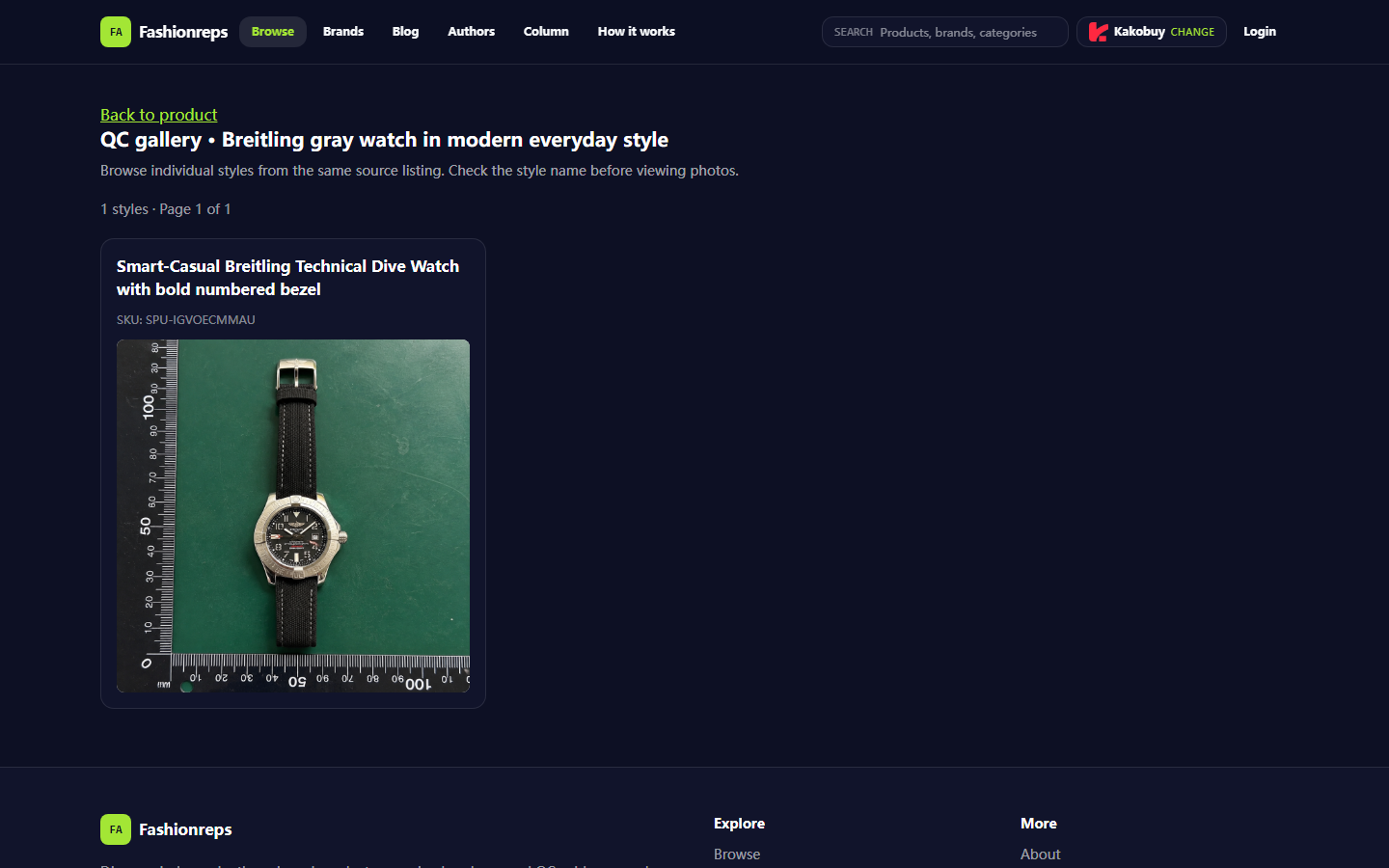
- Style name: the page lists "Smart-Casual Breitling Technical Dive Watch with bold numbered bezel."
- SKU: the page shows SPU-IGVOECMMAU.
- The currently selected color, size, or other variant info; if the page has no such fields, note "not shown."
- The date and time the QC page was opened.
The page content shows this product has 1 viewable style, and the QC page should correspond to the specific style name. If the detail page has multiple similar styles, you must verify the style name before entering the QC photo page. Similar names don't mean the same product, especially when dial color, bezel numbers, and strap configuration differ.
If the product title, style name, SKU, or page variant can't be matched, pause. Don't use QC photos from another watch as evidence for the current product. 🧭
Use View QC Photos to Check You're in the Correct Product Gallery
After entering the product detail page, use the page's View QC Photos or equivalent QC photo entry. Check these correspondences on the page:
- Does the QC page still show the target product name?
- Is the style name on the page consistent with the detail page?
- Does the page show the same SKU or other unique product identification?
- Are the photos from the same set, rather than from different products or batches?
- Is the photo count abnormal, such as only one, all duplicates, or empty after loading?
Don't just look at image file names. File names may not indicate style and batch; the combination of page title, style name, and SKU is better for confirming ownership.
If the QC page jumps to an empty gallery, a tab, an error page, or a different style, first save the page appearance and time, then confirm through the platform's official help channel. When ownership cannot be confirmed, don't base your ordering decision on these photos.
What Angles Are Needed for Dial, Case, Strap, and Clasp
Different sellers or warehouses may take different numbers of photos, so the focus isn't a fixed count but whether key areas are visible, clear, and not blocked by reflections or cropping.
| Area | At least should be able to observe | Common evidence gaps |
|---|---|---|
| Dial and hands | Overall front, markers, hands, date window or other details claimed on page | Only distant shot; reflection blocking; markers illegible; partially cropped |
| Case and bezel | Front outer edge, left and right sides, lugs, crown, and bezel edge | No side view; crown blocked; bezel edge blurry; suspected impact site not visible |
| Strap | Front and back of strap, connection points, adjustment area, and visible texture | Only worn side photographed; connection missing; strap edge folded and hidden |
| Clasp | Closed state, open state, inner and outer sides, and connection parts | Only closed front; inner engravings invisible; clasp covered by hand or packaging |
Having a photo of a part doesn't mean that part has been verified. Photos should be clear enough to observe appearance defects, mismatches, obvious scratches, color deviations, or structural abnormalities; if you can only see the outline, classify it as "visible but not assessable."
For easily overlooked areas like the crown, lugs, clasp inner side, and strap connection, list them separately. They are often not in the main front photo; don't assume they're normal just because the main subject is clear.
How to Categorize Evidence Gaps When Photos Are Blurry, Duplicate, or Missing
Use a consistent recording method to avoid vague descriptions like "not enough photos." Each entry includes: location, issue, angle needed for reshooting, and whether it affects your current decision.
You can categorize as follows:
- Missing: no photo of that part at all, e.g., no clasp open state.
- Blurry: photo exists but key details are illegible, e.g., markers or inner clasp markings unreadable.
- Duplicate: multiple photos are the same angle, still not covering sides or back.
- Blocked: fingers, packaging, reflections, or cropping hide the area to assess.
- Mismatched: color, dial, strap, or structure in photo doesn't match the detail page selection.
- Insufficient: photo shows appearance but cannot prove the specific concern, e.g., cannot prove timekeeping or water resistance from a photo.
When recording, don't write "looks authentic," "probably no scratches," or "quality is good." These statements exceed what photos can prove. Instead, write like "Dial front visible, but reflection on marker area prevents detail confirmation," which is more actionable for reshooting and review. 📝
How to Submit a Reshooting Request and Specify Exact Locations
The reshooting request should be specific about part and angle, and as complete as possible in one message to reduce back-and-forth. Write in this order:
- State the product title or SKU.
- State what the current QC photos already cover.
- List the missing or unassessable areas.
- Specify the desired direction, state, and distance for reshooting.
- Explain the appearance issues to check after reshooting.
For example, you could make these requests:
- Please provide a close-up of the dial front, avoiding reflections on markers, hands, and date window.
- Please provide photos of the case left and right sides, crown, lugs, and bezel edge.
- Please provide photos of the strap connection points, strap back, and adjustment area.
- Please provide separate photos of the clasp closed, open, and inner/outer sides.
- If there are obvious scratches, dents, or color inconsistencies, please provide a close-up of that area and a broader locating shot.
Don't request photos that ordinary photos cannot prove, such as movement authenticity, timekeeping accuracy, or water resistance. Also don't ask for photos to be beautified, flaws hidden, or only the "best" angles. The purpose of reshooting is to add verifiable information, not to change the product impression. ✅
After submitting, save the request content and submission time, and wait for new QC evidence to be added to the same product record. If the reply gives only a vague confirmation without new photos or specific explanations, still treat it as "evidence not supplemented."
What Visible Photos Can Support and What They Cannot Prove
Sufficiently clear and properly attributed QC photos can typically support these judgments:
- Whether the selected color, dial style, and strap configuration are clearly inconsistent.
- Whether there are visible scratches, dents, stains, damage, or assembly misalignment.
- Whether the clasp, crown, or strap connection shows obvious structural abnormalities.
- Whether key areas still lack evidence.
But photos cannot alone prove:
- That the product is genuine or brand-authorized.
- Movement model, timekeeping performance, water resistance rating, or long-term durability.
- Materials, dimensional accuracy, weight, and functions not shown on the page.
- Seller inventory, after-sales promises, return/exchange terms, or final shippable status.
- Shipping, customs clearance, and destination country import compliance outcomes.
Therefore, conclusions from QC photos should be written as "current photos support or do not support a certain appearance judgment," not expanded into a guarantee of overall product quality.
Checklist for Continue, Pause, or Stop Before Evidence Is Complete
Situations where you can continue:
- Product title, style name, SKU, and QC photos match.
- Key areas are clearly visible with no blocking that affects judgment.
- Your concern is an appearance issue that photos can verify.
- New photos after reshooting are indeed added to the same product record.
Situations where pausing is recommended:
- Only one or two specific angles missing and can be resolved with a concrete reshooting request.
- Photos exist, but reflections, cropping, or distance make key details unassessable.
- Page information mostly matches, but variant or batch still needs confirmation.
- Platform has acknowledged the reshooting request, but new evidence hasn't arrived.
Situations where you should stop using current QC photos to proceed with ordering:
- Product identity, style, or SKU cannot be matched.
- QC photos clearly belong to another product.
- Key areas repeatedly missing, or after reshooting still blurry, duplicated, or blocked.
- You find color, structure, strap, or clasp inconsistent with the selected style.
- You need to confirm something photos cannot prove, such as authenticity, movement, water resistance, or timekeeping.
- Page shows an empty gallery, error redirect, or other unexplained anomaly, and official channels haven't confirmed.
The final decision should be based on complete, properly attributed evidence that answers your specific questions. Reshooting isn't to make the product "look better," but to let you know what you have seen and what remains unknown. Before evidence is complete, pausing is usually safer than filling gaps with guesses.
Shopping FAQs on Agent Platforms
1. On usfansus.com, how do I evaluate if a product's quality is good?
To figure out if an item meets your standards on usfansus.com, you should look carefully at the QC images provided. Do not trust factory photos alone since they are often edited or enhanced. By checking the QC pictures, you can see if the product's specific details match what you asked for before you decide to buy it. Also remember to stay away from very cheap listings on usfansus.com, because those items usually come with poor quality.