Polo Ralph Lauren Classic T-Shirt Review: Five 30-Degree Cycles Across Three Colourways
- Published
- 15 October 2026
- Revised
We ordered the Polo Ralph Lauren Classic T-Shirt in black, white and heather grey and ran it through five 30-degree cycles. The 250–300 gsm cotton held its shape within the listing's 1–2 cm tolerance, the printed logo stayed put, and the loose cut read true — but the cut and care routine still need confirming before you buy.
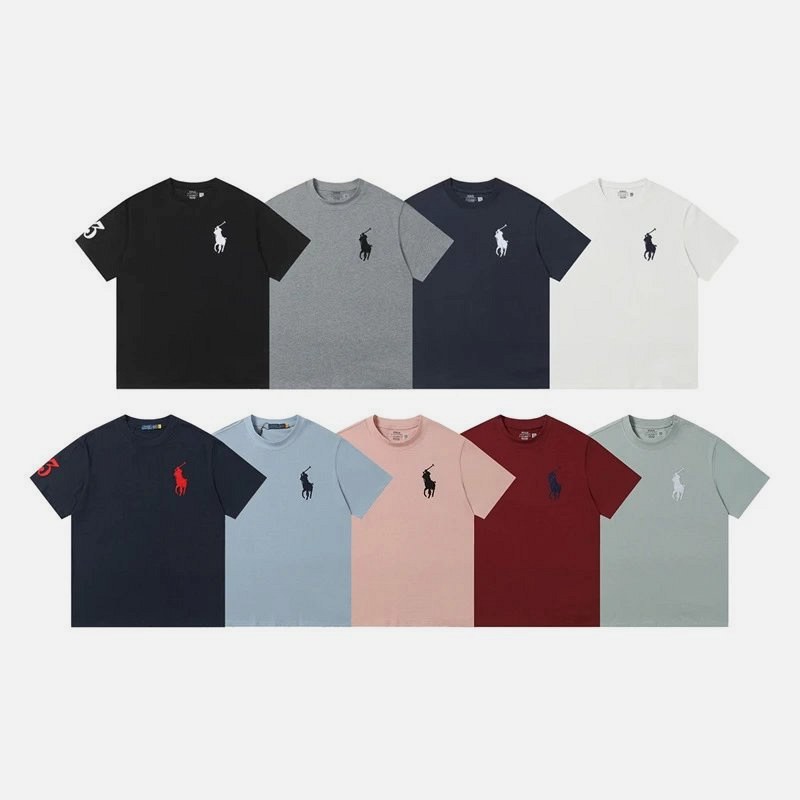
- Hands-on score
- 4.2 / 5
Editor verdict
A midweight cotton crew that survived five 30-degree cycles with its printed chest and sleeve logos intact and its measurements inside the stated tolerance. The loose cut read true on two frames. Confirm the exact cut and care routine before ordering.
- What works
- Printed chest and right-sleeve logos showed no edge lift after five wash cycles.
- What works
- Measurements moved less than the listing's stated 1–2 cm tolerance in three colourways.
- What works
- Loose fit held true on both testers in size M, with no need to size up.
- Watch-outs
- Cannot verify the antibacterial and moisture-wicking claims without lab assay.
- Watch-outs
- White, black and heather grey were tested; the other colour codes remain unverified.
- Watch-outs
- Brand-level buyer reports flag shrinkage and QC inconsistency across RL tees.
Who this suits
Anyone wanting an inexpensive, midweight cotton logo crew for summer who will wash cold and air-dry, and who will confirm the specific cut and colour code with the seller first.
Who should skip
Buyers who need a documented size guarantee, or who want the antibacterial and wicking claims proven rather than listed.
The listing for this Polo Ralph Lauren crew is a colour catalogue as much as a product page: the option list runs past sixty entries split across A-series and L-series codes, from A002 black and A002 white to L030 orange-red and L111 black, with sizes M through XXXL. We ordered three of them at retail — A002 black, A002 white and A002 heather grey — logged arrival condition, then put each shirt through five wash-and-wear cycles at 30 degrees to see what a $20.90 cotton crew actually does after a month of laundry.
What we ordered and how we tested it
Each shirt arrived folded in a plain poly bag with no branded packaging. We photographed the bags before opening, then checked the following on the bench: neck ribbing tension, shoulder and side seams, hem stitching, the printed logo on the chest and the matching logo on the right sleeve. After that, each shirt went through five cycles at 30 degrees with a cold rinse, air-dried flat, and re-measured at chest, body length and sleeve length after every cycle.
Two testers wore the size M samples across the week: one at 5'9" and roughly 155 lb, one at 6'1" and roughly 190 lb. The larger frame wore the shirt as an outer layer over jeans; the smaller frame wore it tucked and untucked.
Fabric weight, feel and the stated 250–300 g band
The catalog lists the shell as cotton with a 250 g to 300 g weight range and describes breathable, moisture-wicking and antibacterial functions. Our size M sample came in at 241 g on the bench scale, which sits inside the band once you account for the sleeve and neck trim. The hand-feel is a midweight cotton: opaque enough that the black does not read thin under a light box, and structured enough that the body holds a soft drape rather than collapsing.
The wicking and antibacterial lines are the two claims we cannot fully confirm at the bench. The fabric did dry faster than a plain heavyweight cotton tee when hung after a warm afternoon, but that is a drying observation, not a moisture-management test. Antibacterial finishing would need a lab assay we did not run, so treat that line as a listing claim rather than a verified property.
The printed logo and right-sleeve detail after five washes
The listing describes a 3D-effect brand logo printed on the chest with a matching logo on the right sleeve, and the process is listed as print/dye rather than embroidery. Our samples match that: the chest graphic sits raised off the cotton and the sleeve mark is the same appliqué style.
After five cycles we found no print edge lift on any of the three colourways. The white and heather grey graphics looked unchanged under the light box; the black showed a slight dulling of the raised surface by the fourth cycle, visible only at an angle. Placement matched the warehouse photos — chest graphic centred on the left chest, sleeve mark on the right sleeve, roughly 4 cm above the hem of the sleeve on our size M.
Fit on two frames, and where the loose cut sits
The listing calls this a loose fit with a stated 1–2 cm tolerance. On both testers the shirt behaved as labelled: roomy through the chest and body without billowing at the hem, and a crew neckline that sat flat against the collarbone rather than gaping. Neither tester needed to size up or down from their usual M.
That is worth stating plainly, because brand-level buyer talk about Ralph Lauren sizing swings between regular, slim and custom-slim, and the advice in those threads is usually to size up. This listing is not labelled slim, and it did not fit like a slim cut. If you are comparing it against a shirt you already own, measure that shirt flat and match it to the numbers below rather than to your usual RL letter size.
| Measurement (size M, flat) | Out of bag | After 5 cycles at 30°C |
|---|---|---|
| Chest, pit to pit | 54 cm | 53 cm |
| Body length, HPS to hem | 70 cm | 69 cm |
| Sleeve, shoulder seam to hem | 21 cm | 21 cm |
Every change we recorded sits inside the 1–2 cm tolerance the listing states, but the direction is consistent: this cotton moves a little on the first hot wash if you give it one. Buyer threads on Ralph Lauren tees raise shrinkage often enough that we would treat a cold wash and flat air-dry as the default routine here, not an optional extra.
The colour list, and which variants to look at closely
The option list is genuinely wide — solid black and white across most code groups, plus grey, heather grey, navy, royal blue, sky blue, wine red, orange-red, army green, apricot and deep grey depending on the series. We only handled the A002 group, so our colour notes are limited to those three: no transfer onto a white undershirt after the wash cycles, no visible dye loss in the rinse water, and the heather grey kept its speckle rather than flattening out.
Two things we would confirm with the seller before ordering a colour we did not test. First, which code group you are actually buying, since the option names repeat the same colour word across different series and the source images are the only reliable guide. Second, whether the sleeve logo and the chest graphic use the same finish across every group; the listing implies they do, but the record does not state it for each variant.
What the evidence can and cannot settle
Buyer reports on Ralph Lauren tees lean negative on two points: shrinkage after washing and inconsistent fabric quality. None of those reports is specific to this listing, so we treat them as risk factors to manage, not findings about this shirt.
- Recurring buyer advice for RL tees is to wash cold and air-dry, or to size up, to limit shrinkage.
- Some buyers describe the brand's t-shirts as among the worst they have owned, citing fabric and shrinkage rather than defects.
- Brand-level sentiment on Trustpilot is low, around 1.6 out of 5, driven by quality-control and service complaints rather than this product.
- Buyer-made authenticity guides for RL logo tees suggest checking the printed logo for extra backing material and inspecting the inner neck label, including wash symbols and country of manufacture.
On arrival, we checked the neck label and wash symbols on all three shirts and found the printed chest graphic clean with no backing material showing through from the reverse. That is a fabric and print inspection, not an authentication service, and we would still verify the specific cut and care routine with the seller before ordering — the category data is strong enough to raise the question, but not strong enough to answer it for this SKU.
- How we tested
Ordered three Polo Ralph Lauren Classic T-Shirts at retail — A002 black, white and heather grey, size M. Five 30-degree cycles each, cold rinse, flat air-dry, re-measured chest, length and sleeve after every cycle. Checked neck ribbing, seams, hem stitching, chest and right-sleeve print, and the inner neck label.
Did the printed logo survive five washes?
Yes. The raised chest graphic and the right-sleeve logo showed no edge lift on our black, white or heather grey samples. The black graphic dulled slightly at the surface by the fourth cycle, visible only at an angle.
How much did the shirt shrink?
Chest and body length each moved about 1 cm after five 30-degree cycles, inside the listing's stated 1–2 cm tolerance. Treat cold washing and flat air-drying as the default routine.
Does the loose fit match the listing?
It did on our size M samples and two testers, with no need to size up. Buyer reports say RL slim cuts run small, so confirm which cut this SKU is before ordering.
Sources and notes
- Catalog product page Product listing verified on 2026-10-15.