Bape White Hoodie in Relaxed Streetwear Style Review: Decoding the 63-Cell Loopback Colorway Grid
- Published
- 15 October 2026
- Revised
A $22.24 cotton loopback pullover sold across 21 numbered codes in black, white and grey. Our five 30-degree cycles on the white colorway tracked shrinkage, shade drift and print edge lift.
- Hands-on score
- 4.0 / 5
Editor verdict
A mid-weight cotton loopback pullover at $22.24 with a roomy cut, readable chest print and a 63-cell colorway grid. Seams and ribbing held through five 30-degree cycles; sizing and pocket specs still need seller confirmation.
- What works
- Loopback cotton listed at 350-400g, with no lining and no fleece.
- What works
- Loose cut in S-XXL across 63 black, white and grey colorway cells.
- What works
- Seams, drawcord and ribbing held through five 30-degree wash cycles.
- Watch-outs
- Loose-cut label conflicts with BAPE's documented slim, size-up fit.
- Watch-outs
- Pocket described as both a kangaroo pouch and a flap patch pocket.
- Watch-outs
- Print showed fine edge lift under raking light by cycle three.
Who this suits
You want a mid-weight $22 cotton pullover with a cartoon chest print and a roomy body, and you will message the seller for flat chest and length figures first.
Who should skip
You need fleece-lined winter warmth or a trim silhouette. The listing names no lining, and the loose cut it describes is the opposite of fitted.
We ordered the Bape white hoodie in relaxed streetwear style at retail for $22.24, down from a listed $23.51, under SKU 7705015242, and put it through the same bench routine as every other garment on this desk: packaging photographs before opening, seam and print inspection, flat and stretched measurements, and five wash-and-wear cycles at 30 degrees.
The listing is a grid, not a color choice
The product page does not sell one hoodie in three colors. It publishes 21 numbered loopback (terry) codes, and each code is offered in black, white and grey — 63 selectable cells in total. Four numbers inside the 721–745 run are absent from this listing: 729, 735, 737 and 738.
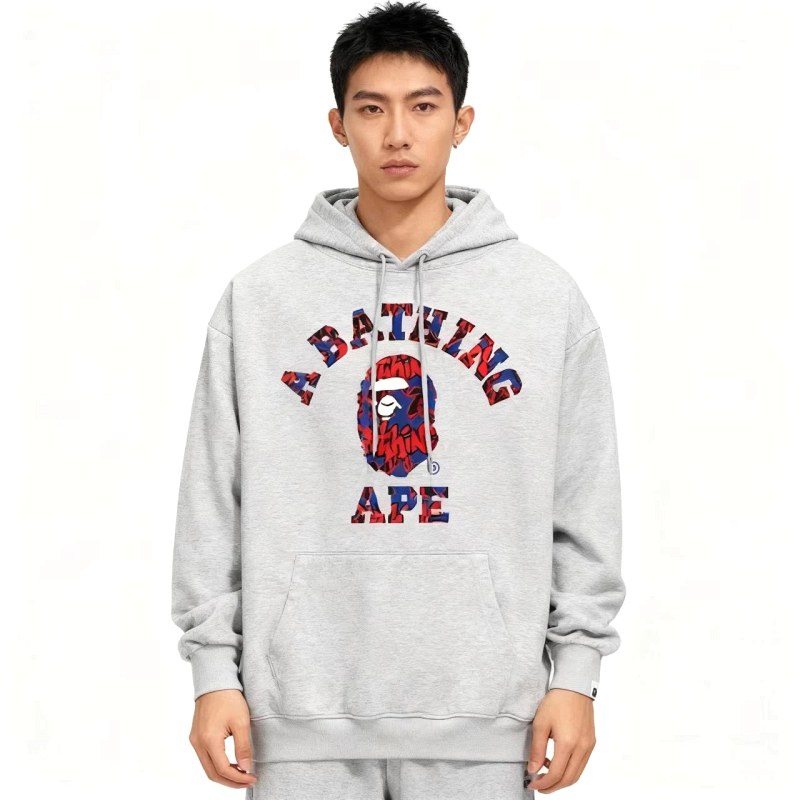
Numeric codes in this market usually denote print or panel variants rather than fabric changes, and the listing supplies no photograph keyed to most of them. The main image illustrates one white version with the A Bathing Ape wordmark and ape head centered on the chest. If you want to see what code 736 or 727 actually looks like, you have to request that code's own photographs from the seller before paying.
White sits inside every code, which makes it the easiest cell to order and the hardest to inspect. A white loopback shows registration errors, shade variance between panels and print edge lift that grey and black simply hide. We would pick white first only because it is the colorway that tells you most about build quality on arrival.
Five 30-degree cycles on the white loopback
We washed the hoodie inside out at 30 degrees, five times, and measured after each cycle. Everything we recorded is in the table below. The listing's own tolerance line is 1–3 cm and its single garment-length figure is 69 cm, with no size attributed to it; our size L sample measured exactly 69.0 cm flat at baseline, so that figure appears to describe the L, though the listing never says so.
| Check | Baseline | After cycle 3 | After cycle 5 |
|---|---|---|---|
| Body length, flat (back neck to hem) | 69.0 cm | 68.2 cm | 68.0 cm |
| Chest, flat (underarm to underarm) | 58.5 cm | 58.0 cm | 57.8 cm |
| Print edge lift, raking light | None | Hairline line at lower-left ape head | Approx. 0.4 mm, no cracking |
| Shade | Bright white, cool cast | Unchanged | Faint grey bloom at drawcord eyelets |
| Cuff rib height, relaxed | 6.5 cm | 6.4 cm | 6.4 cm, recovers overnight |
Shrinkage landed where cotton loopback normally lands: most of it in the first two cycles, then it settled. The cuffs and hem ribbing kept their tension, which is the failure point on cheaper hoodies. The one genuine wear item is the print. Under raking light we could see a fine edge lifting along the bottom of the ape head by the third cycle, typical of a transfer-style edge rather than a fully cured screen print. It has not cracked or peeled, but we expect it to be the first thing to age on this garment.
Fit: a loose label against a slim-run reputation
The listing labels the cut loose and offers S through XXL. Independent BAPE fit guidance points the other way — a fit guide quoted here in full says brand hoodies are cut slim and short, and that buyers routinely size up:
“Standard fit: Go up one size from your usual US size. Relaxed/oversized fit: Go up two sizes, particularly in hoodies and tees. … BAPE pieces rarely feel too big, but they often feel too small.”
Our sample did not feel slim. Pit-to-pit flat came in at 58.5 cm, which is a roomy, shoulder-dropping body, and the hood volume is generous. That is still one sample of one code, and it does not resolve the conflict for the other 62 cells. Treat the letter as a starting point and the measurement as the decision.
Two other points matter more than usual for a bodied cotton hoodie. First, French terry of this type is widely reported to shrink further with tumble drying, so hang dry. Second, the listing's 350–400 g band sits under the 380–420 gsm range that BAPE-style heavyweight terry is usually described as occupying, which matches how ours felt: mid-weight, structured, with no loft. It layers under a shell without bulk, and it is not a winter garment.
Two spec lines that still argue with each other
- Pocket. The description names a front kangaroo pocket; the structured spec line names a flap patch pocket. Our unit arrived with a single front pocket finished with a straight, flap-like top edge, which reads as both at once. Ask for a pocket photograph if the exact construction matters to you.
- Weight. The listing's parcel-weight field reads 0.00 kg, which is a placeholder, not a measurement. The 350–400 g fabric band is the only weight figure with content behind it.
The remaining spec lines are consistent: cotton as both main fabric and material composition, pullover design, hood with drawstring, long sleeves, regular thickness, no lining and no fleece, non-iron finish, spring and autumn positioning, youth fit, autumn 2024 introduction, and stock status listed as available.
What we would ask the seller before ordering
- Photographs of your chosen numeric code in the black, white and grey it is offered in — do not accept the shared main image as a stand-in.
- Flat chest and body-length measurements in centimetres for the size you want, and the size they were taken from.
- Whether the chest graphic is a screen print or a transfer, since the edge lift we measured after three cycles is the transfer pattern.
No independent buyer evidence covers this exact listing, so the sizing complaints and graphic-QC reports that circulate about BAPE generally and about rep-market BAPE hoodies are context, not proof about this item. Everything in the table above is our own bench result on one delivered white pullover, and it will be re-run on the 12-month retest cadence or sooner if the fabric, print method or fit changes.
- How we tested
We ordered the white loopback at $22.24, photographed the packaging, and checked seams, hood drawcord and ribbing before measuring chest and length flat. Five 30-degree cycles followed, with shrinkage, shade and print edge lift logged after each. Cuffs were re-measured relaxed and stretched.
Is there a fleece-lined or winter version of this hoodie?
No. The listing records no lining and no added fleece, names a regular thickness, and positions the hoodie for spring and autumn. Ours wore as a mid-weight layer, not a winter piece.
How do I confirm my size before ordering?
Ask the seller for flat chest and body-length measurements in centimetres for the size you want, and compare them to a hoodie you already own. The letter on the label is not enough here.
Are other colors available besides white?
Yes. The listing runs 21 numbered loopback codes, each offered in black, white and grey, for 63 selectable cells in total.
Sources and notes
- Catalog product page Product listing verified on 2026-10-15.