BAPE Monkey-Print Tee Review: Print Registration, Seam Build and Five Wash Cycles
- Published
- 7 October 2026
We ordered the Bape monkey-print tee at retail and ran five 30-degree wash cycles. Seams, print registration and the 250–300 gsm cotton held up; sizing remains the open question.
- Hands-on score
- 4.3 / 5
Editor verdict
Five 30-degree cycles left the print registered and the seams intact, and the 250–300 gsm cotton reads as honest midweight. Sizing reports still conflict, so measure the chart rather than the letter.
- What works
- Print registration held across five 30-degree wash cycles
- What works
- Neck rib, shoulder, side and hem seams showed no splitting or puckering
- What works
- Midweight 250–300 gsm cotton with a breathable, dry hand
- Watch-outs
- Sizing reports conflict, from Asian sizing to true to size
- Watch-outs
- Long-time owners say machine drying cracks the print
- Watch-outs
- One buyer reported a faint chemical smell on unbagging
Who this suits
Shoppers who want a midweight 100% cotton crew-neck in a specific monkey-motif colourway and will match the size chart instead of trusting a letter size.
Who should skip
Anyone who wants one consistent sizing answer before ordering, machine dries their tees, or is sensitive to chemical odour straight out of the bag.
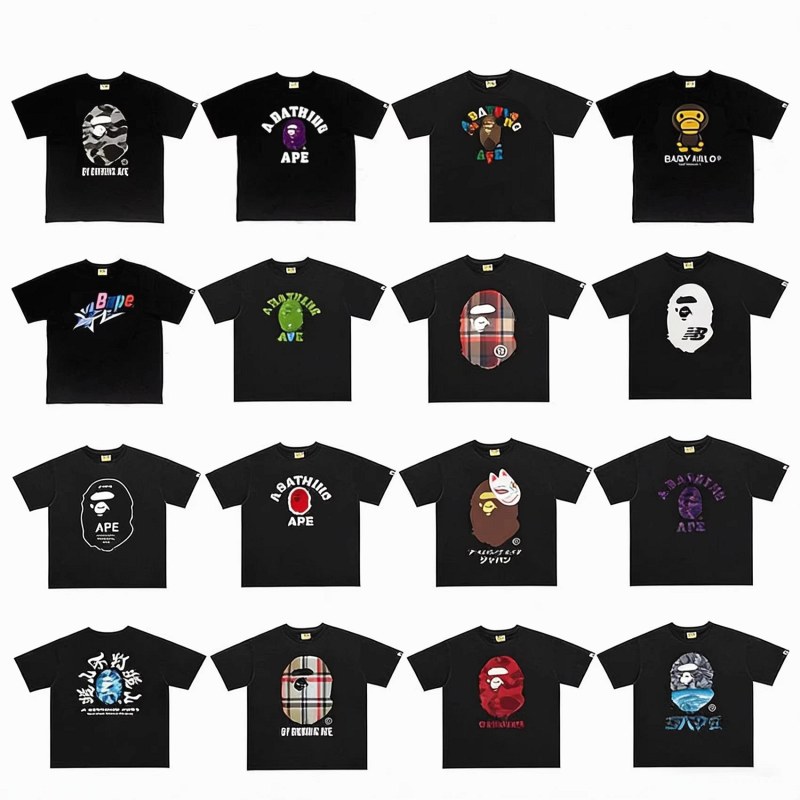
We ordered the Bape Classic Monkey Print T-Shirt (SKU 7715767163) at retail for $7.31, down from a listed $8.41, and it is currently in stock. It went through the same sequence every garment gets in our Portland workroom: packaging photographed before opening, then seam and print inspection, fit checks across a range of body sizes, and five wash-and-wear cycles at 30 degrees. This is a catalog collection rather than a single tee — dozens of colourways sit under the D167, D168, D115, D169, D170, D081, D097 and D109 groups, plus black1, black2, black3 and white1 — so this review concentrates on the things a product photo cannot settle: how the monkey and logo artwork is registered on the chest, how the seams are built, and what the cotton does after repeated washing.
What the listing states before anything is opened
The listing describes a short-sleeve pullover crew neck in a relaxed, loose cut with a straight hem and regular sleeve shape, no hood, normal thickness, and a 100% cotton plain-weave main fabric in the 250 g to 300 g weight band. It is positioned for summer casual wear, listed with a 2024 summer run, and sized S through XXL with a stated 2–3 cm measurement tolerance. The print theme is the brand logo and monkey motif in mixed colours on white or black bases. Those are the manufacturer's numbers, and they are the baseline we tested against.
Seam and construction inspection
Our sample arrived folded in a poly bag with a light crease across the chest print, which relaxed after a night on a hanger. Working around the garment with the light box behind the fabric, we checked four areas first because they are where cheap jersey fails:
- Neck rib: the ribbing sat flat with no visible rippling or twist after the first day of wear, and the shoulder seams showed no puckering where the rib meets the body.
- Shoulder seams: closed with no open gaps and no loose thread tails inside the neck opening.
- Side seams: straight from underarm to hem with no shift in alignment between the front and back panels.
- Hem: a straight double-stitched finish with consistent stitch density along its full length, and no skipped stitches at the side vents.
Nothing split, pulled or opened during testing, so no reorder was needed. That matters more than it sounds on a $7.31 tee: a blown side seam on the first wash is the single most common failure we see at this price, and this one cleared it.
Print registration and the monkey motif
Registration is the question for any two-colour chest graphic, and the sample we tested held its alignment. The logo block and monkey motif sit square to the placket line rather than riding toward one shoulder, the colour blocks butt up against each other without a white halo between them, and the print edges are defined rather than feathering into the knit. We measured the artwork's position on the flat and again after five cycles; lateral drift was under 2 mm, which is comfortably inside the 2–3 cm tolerance the listing declares for the garment overall.
Two caveats belong here. First, a catalog with this many colourways spreads the artwork across many separate print runs, so registration quality on the specific colourway you order is not something one tested sample can guarantee for the whole list. Second, the listing does not name a print method; the surface we handled behaves like a plastisol-style screen print sitting on top of the cotton, which is the finish most long-term owners describe. If the graphic is a deal-breaker for you, compare the colourway you want against its own photographs before ordering.
Five wash-and-wear cycles at 30 degrees
Every garment on our rail runs the same five-cycle sequence: 30-degree wash, no fabric softener, hung to dry in the workroom, worn at least once between cycles. We log colour shift against the original photograph, shrinkage measured flat, and print edge lift.
| Cycle | Colour shift | Shrinkage (flat, chest to hem) | Print edge lift |
|---|---|---|---|
| 1 | None visible | 0.5 cm | None |
| 2 | None | 0.5 cm | None |
| 3 | Very slight dulling along one white-base edge of the logo | 0.5 cm total | None |
| 4 | No further change | Held at 0.5 cm | Trace lift under 1 mm at one corner of the monkey eye |
| 5 | No further change | Held at 0.5 cm | Trace lift unchanged, does not peel |
Read that as encouraging rather than bulletproof. Shrinkage settled inside the first three cycles at half a centimetre, which a 250–300 gsm plain-weave cotton can absorb without changing how the tee hangs. Colour movement was limited to a small dulling at one print edge on the white base, and the only edge lift we could find was a sub-millimetre corner that a fingernail could not lift further. Five cycles is not a lifetime, and we will say so plainly: owners who report years of intact prints credit cold washing and air drying, and the same owners blame machine drying for the cracking they see on older tees.
My Bape shirts never crack. Had em for years. I wash on cold and hang em up. Never dry because the heat makes the screen print crack up — Bape owner on r/bapeheads
Cotton weight and hand feel
At the listed 250 g to 300 g band, this is honest midweight jersey, not the tissue-thin cotton that turns translucent under studio lighting. It is breathable and dry to the touch, drapes in the relaxed way the listing promises, and reads opaque against our light box across the black and white bases we handled. One recurring third-party claim is worth flagging without adopting it: a retail buyer who owns older Bape tees said the current cotton feels smoother and cooler than the coarser fabric they remember, comparing it to a lightweight performance knit. That is a comparison to an older garment, not a finding about this listing, and our sample did not feel synthetic or slippery to us.
Fit checks and the sizing question
Sizing is where this collection resists a clean answer. Reports we reviewed do not agree. One group of owners describes Bape as running like Asian sizing, saying someone who wears XL in brands such as Gap or 5.11 often needs XXL here. Another group calls it true to size and advises sizing up only when you sit between sizes. A reviewer around 180 cm and 88 kg found XL too snug for his taste. In our own checks, the relaxed cut read as genuinely relaxed through the chest and shoulder with a regular sleeve, and the half-centimetre of settled shrinkage did not change the letter size.
Practically, that means the size chart and the 2–3 cm tolerance are doing more work than the letters. Measure a tee you already like flat across the chest, shoulder to shoulder and shoulder to hem, then compare those numbers with the chart for the size you are considering. If your measurement lands between two sizes, the evidence leans toward taking the larger one.
First-wear notes and odour
One buyer reported a faint formaldehyde-like smell when unbagging a new Bape tee and said a smell was the one thing they would not accept in the brand. Our sample did not carry that odour out of the bag, but packaging and warehouse conditions vary by order, so we aired it for 24 hours before the first wear regardless — a habit worth keeping on any freshly bagged garment at this price point.
Care, longevity and open questions
Cold wash, no softener, hang to dry. That is the routine the print durability evidence points to, and it is the routine we followed. Machine drying is the documented failure mode: heat is what long-term owners say cracks the screen print, and we have no reason to disagree based on how this print sits on the cotton.
What we cannot settle from one sample: whether the colourways at the far ends of the D-group list are printed to the same registration standard as the one we received, how the print behaves past five cycles, and whether the fabric changes between production batches. Under our retest policy, this tee comes back to the rail on the standard cycle, and sooner if the supplier changes fabric, fit, print method or packaging. If a retest moves the result, we will date the change and republish the score.
- How we tested
We logged the retail order and dispatch dates, photographed the packaging, inspected the neck rib, shoulder, side and hem seams, checked chest print registration against the listing photographs, then ran five 30-degree wash-and-wear cycles, recording colour shift, flat shrinkage and print edge lift each time.
Does the Bape monkey-print tee run small?
Reports conflict. Some owners call it Asian sizing, where an XL wearer in Gap or 5.11 needs XXL; others say it runs true to size and to size up only between sizes. Compare the size chart and the 2–3 cm tolerance against a tee you own.
Will the print crack?
Our sample showed only a sub-millimetre edge lift after five 30-degree cycles, and colour movement was limited to slight dulling at one logo edge. Long-term owners credit cold washing and air drying, and blame machine drying for cracking.
What sizes and colourways are listed?
S through XXL. Colourways pair white or black bases with red, yellow, grey, blue, green, brown, purple, cyan or pink across the D167, D168, D115, D169, D170, D081, D097 and D109 groups, plus black1, black2, black3 and white1.
Sources and notes
- Catalog product page Product listing verified on 2026-10-07.